Soft handovers with WCDMA are
very different to the handovers used in the GSM system and this
basic principle stems from the US system CDMA. Basically the
MS is connected to more than one BTS (Base Station Transceiver)
at a time. The reason for this is to reduce interference into
other cells (BTSs). It also has the advantage of improving performance
through macro diversity.
Figure 34 illustrates a soft handover principle. The uplink
signal fro the MS is received by both BTSs, which, after demodulation
and combining, pass the signal forward to the combining point,
typically this is the BSC. From a downlink point of view the
same information is transmitted via both BTSs, and the MS receives
the information from both of the BTSs as a separate multipath
signals and can therefore combine them.
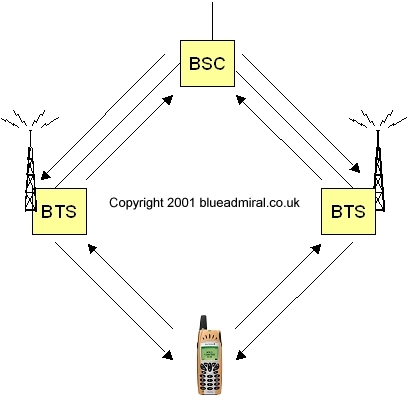
Figure 34 Principle of soft
handover with two base station transceivers (BTS)
Infrequent handovers are needed for utilizations of a hierarchical
call structures; macro, micro and indoor cells. Several carriers
and inter-frequency handovers may also be used for taking care
of high capacity needs in hot spots. Infrequent Handovers will
be needed also for handovers to the 2G systems (See UMTS). There
are two methods that are being considered for WCDMA, (1) Dual
Receiver and, (2) Slotted Mode.