Radio Air Interface
One of the most interesting interfaces in the GSM network is the Um, the Radio Air Interface because it comprises many of the mechanisms used for multiplexing and media access. GSM utilises SDMA (Space Division Multiple Access) using cells with BTS and assigns an MS to a BTS. What's more, FDD (Frequency Division Duplex) is used to separate the downlink and uplink as shown in Figure 5.
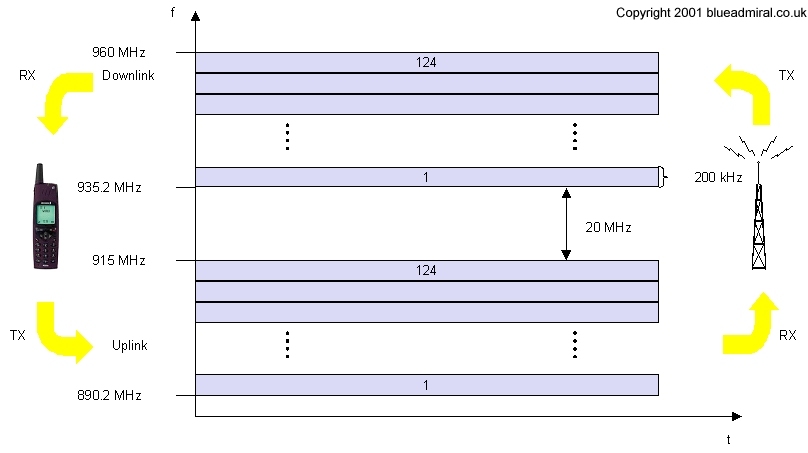
Media access combines TDMA and FDMA. In GSM 900 there are 124 channels, each 200KHz wide and are used for FDMA, however in GSM 1800, there are 374 channels used. The following is an example based on the GSM 900 system, while figure x.iii shows the FDM in GSM. Figure 6 shows TDM in use. Each if the 248 channels is additionally separated in time by using a TDM GSM frame. i.e. each 200 kHz carrier is subdivided into frames that repeated continuously. The duration of a frame is 4.615 ms which is subdivided into 8 GSM time-slots, where each slot represents a TDM channel and lasts for 577 ms. Hence each TDM channel occupies the 200 kHz carrier for 577 ms every 4.615 ms.